
USCF Release Status Paths
Utah State Correctional Facility is part of UDC's statewide prison system. The Board of Pardons and Parole decides parole and sentence termination within Utah law. UDC records custody and carries out release. AP&P supervises a parolee after the person enters the community.
A transfer is different. Moving from USCF to CUCF, a county contract bed, or a community correctional center can trigger a location or VINE change while the sentence continues. Always pair the destination with legal status. “Not at USCF” does not prove release from UDC custody.
Check a USCF Release
UDC Offender Search covers people currently under UDC jurisdiction or supervision. That scope includes a parolee but may exclude someone after full discharge. The Board search supplies hearings and decision orders, which may remain useful when the current UDC result changes.
- Open the UDC Offender Search and search by the exact name or offender number.
- Compare the offender number, photo if shown, legal status, placement location, and relevant date fields.
- Search the same person in Board Hearings and Decisions.
- Open the newest order and check for any later modification, rescission, or review.
- On the expected day, verify the current UDC status; use VINE as notice rather than final legal proof.
A hearing date says when the Board considers a case. It does not promise release. An order may grant parole, set a rehearing, allow expiration, rescind an earlier date, or produce another result. Read the precise language.
USCF Offender Record Fields
The offender number is the strongest link between UDC and Board systems. Names can vary or match more than one person. UDC also identifies fields such as legal status, placement location, offenses and sentence length, sentencing court and case, prison photo, Board hearing date, and parole or expiration date.
| Record item | Release value |
|---|---|
| Legal status | Shows prison, parole, probation, or another UDC state. |
| Placement location | Shows where custody is reported, not why a move occurred. |
| Board hearing date | Signals review, not an exit day. |
| Parole/expiration date | Relevant date that needs order and status confirmation. |
| Board decision | Provides the controlling public wording and conditions. |
A “parole” status means the person is out of prison but remains under the sentence and AP&P supervision. Full termination or maximum expiration is closer to discharge. Do not merge those terms.
USCF Contact and Records
USCF is in the Salt Lake City area and serves the statewide system. Use UDC's current contact page for facility and records routing because office assignments can change. Use the Board public search before requesting a decision already available online.
1480 North 8000 West
Salt Lake City, UT
Operator: Utah Department of Corrections
UDC contact routing
No telephone or public lobby hours were supplied in the research for this facility, so none are invented. A records request should identify the person, offender number, record sought, and date range. Ask for an existing release entry or status record, not a custom explanation.
Note: A Salt Lake prison record stays with UDC even when the court case or future residence connects the person to Sevier County.
USCF Board Hearing Records
The Board live-hearing page says Salt Lake and USCF hearing-location calendars generally operate Monday through Thursday. That is a site cadence, not an individual appointment. Search the person's result for the actual schedule and later decision.
Original hearings, parole-violation hearings, rehearings, rescission hearings, redeterminations, and paper reviews answer different questions. A later order can replace an earlier parole date. Pending charges, missing reports, behavior, address approval, a detainer, or a new court action can also affect timing.
The official UDC search image shows the state portal used before checking the Board order.
Open the official UDC Offender Search source.
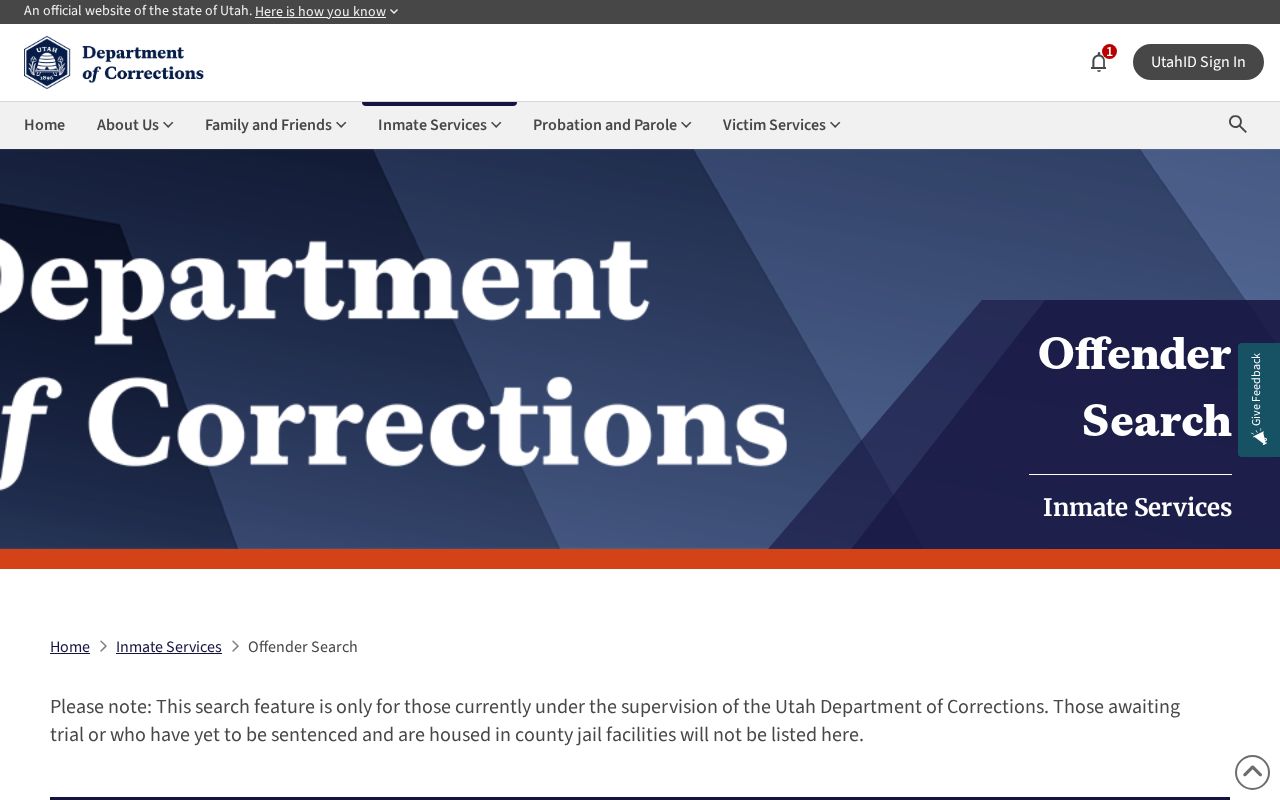
The portal is for current UDC jurisdiction or supervision, so it should not be labeled a complete discharge archive.
USCF Release Date Meaning
Utah state-prison sentences are generally indeterminate. A court imposes a minimum-to-maximum term under section 77-18-111, while the Board acts within that range. A tentative original-hearing month is not a projected release date. A Board order is stronger, yet it can still change while jurisdiction continues.
| Stage | What it establishes |
|---|---|
| Court judgment | Sentence range and credit framework |
| Tentative hearing month | Expected review period only |
| Board order | Parole, review, expiration, or other controlling result |
| UDC status after date | Release-day confirmation |
| VINE event | Notice of release or movement, not the legal calculation |
Utah has no universal 85-percent requirement for every prisoner. Offense-specific restrictions may apply. Program-based earned-time cuts can affect an existing Board date for eligible participants, subject to law and Board contingencies, but they are not automatic day-for-day credit.
USCF and Sevier Custody
Sevier County Jail's mixed population is Angle T. It houses people for three counties and UDC. A USCF prisoner can be transferred to a contract county jail and remain a state inmate. In that situation, the physical site is Sevier, but UDC and the Board still control the state-prison release path.
Ask whether the person left UDC jurisdiction or merely moved. If paroled to Sevier County, verify AP&P supervision from UDC's current office assignment. If transferred to Sevier Jail, confirm the UDC legal status and do not list the event as community release.
USCF VINE Release Alerts
Utah VINE reports events that can include release and moves among prison sites, county jails, and community correctional centers. Register against the matched person and keep the confirmation PIN if the phone method requests it. UDC warns users not to rely only on VINE.
When an alert arrives, record the exact event, agency, location, and last update. Then compare it with UDC status and the newest Board order. A move alert supports a custody change but cannot define parole or discharge by itself.
Request USCF Release Records
For a historic record beyond the current search, ask UDC for the specific existing record. Use the full name, offender number, and date range. Board decisions should be downloaded from the public search first, with the access date preserved.
Utah GRAMA governs access and allows classification or redaction of restricted fields. It does not require the agency to create new analysis. Ask for public portions and the classification cited for withheld material. The Sevier County release overview helps separate state-prison records from county, court, VINE, and federal channels.
USCF Parole Release Supervision
After a USCF parole release, the Board remains the decision authority and UDC Adult Probation and Parole handles field supervision. The person's supervising office should be verified through UDC rather than guessed from a prior home address. An office assignment can change, and staff may limit case details shared with an unrelated caller.
Parole is not sentence termination. A person can live in Sevier County and still remain under Utah state authority until the Board terminates the sentence or the maximum expires. A claimed violation may lead to a Board warrant and return to custody, while a later decision can change the status shown in an earlier record. Read UDC legal status and the newest Board order together.
USCF Release Day Confirmation
UDC's Release Day FAQ tells readers to use Offender Search or the Board site to verify a parole or release date. That creates a two-check method. First, identify the newest Board order and its effective date. Second, review UDC status on or after that date. If the person still appears at a prison site, do not report community release based only on the earlier order.
Transportation, approved residence, a detainer, pending charge, behavior issue, or rescission can affect what happens before departure. The research did not establish a public USCF gate time or pickup schedule, so none should be promised. Direct logistical questions to UDC through the current official contact route.
After release, a parole status and AP&P assignment show continuing state authority. If the UDC result later disappears, that may reflect the end of public current-jurisdiction coverage rather than an error. Preserve the Board order and request an existing UDC record when durable proof is needed. A VINE alert remains supporting notice, not the final source for the legal basis.
USCF Release Search Fallback
If the public offender search has no result, verify the spelling and offender number, then search Board decisions. No match can reflect ended UDC jurisdiction as well as bad identifiers. For a lasting answer, request an existing UDC record and identify the exact date range. Do not treat a missing current result as proof of discharge.