
Sevier County Same-Day Release Status
No populated first-party rolling release list was verified for Sevier County, Utah. The sheriff's OCV site has an official Felony Release Report route, but it showed an unpopulated placeholder during research and did not define a 24-hour window. The separate official inmate-search route was also a placeholder. Neither page published its fields, update schedule, or web retention period. It would be wrong to turn either blank route into a claimed live list.
The fastest affirmative check is the Sevier County Jail at 435-896-2660. Ask whether the person is still held. If not, ask for the time of departure, the release authority, and whether the person entered the community or another agency's custody. The jail houses people for three counties and the Utah Department of Corrections, so departure from the Richfield building can be a transfer rather than release.
Check Sevier County Releases Today
Define the time period before contacting an agency. “Today” may mean the calendar day since midnight or the preceding rolling day. Sevier County uses Mountain Time. A precise range helps staff locate an existing log and prevents a release near midnight from falling outside the wrong window.
- Collect the full legal name, date of birth if known, booking date, and any booking or court case number.
- Call Sevier County Jail and ask if the person is held now. If not, ask when and how the person left.
- Check Utah VINE for a reported custody change. Match more than the name.
- Use Utah Courts Xchange to review any release, bond, dismissal, sentence, or commitment entry near the departure time.
- If state custody is involved, check UDC Offender Search and the Board's decision records.
- For a durable record, request the existing booking-and-release entry through the sheriff's GRAMA form.
For one named person, the full Sevier County released inmate search path explains how county, state, court, and federal sources fit together. A current roster is only a first check.
Sevier County Release Record Fields
Because the placeholder report exposes no working field schema, request the fields the jail may keep in an existing booking or movement record. Not every field is guaranteed to be public. Codes should be read with the agency's own definitions.
| Field | What it can establish |
|---|---|
| Name and booking number | Links the event to the correct booking episode. |
| Booking and release date/time | Shows the custody period and exact recorded departure time. |
| Release reason or authority | Distinguishes bond, court order, dismissal, time served, or another basis. |
| Destination or receiving agency | Shows whether departure was community release or continued custody elsewhere. |
| Charges and case number | Connects the jail event to the controlling court docket. |
| Hold or detainer disposition | Indicates whether another authority took custody. |
A release entry and a court disposition answer different questions. The first states when physical custody changed. The second explains the legal event. A VINE alert is a third layer, useful for notice but not a substitute for either official record.
Request a Sevier Release Log
A focused GRAMA request can seek an existing release log or report when the online route is blank. Use the sheriff's electronic GRAMA form. Name a precise start and end time in Mountain Time. Ask for existing entries, not a custom report that the office does not maintain. Utah law does not require an agency to create a new record or analyze data for a requester.
Request release date and time, the reason or authority, and the receiving agency or destination code. Those fields prevent transfers from being counted as community releases. If part of a record is withheld, ask for the segregable public portion and the classification used for each redaction. The sheriff's published schedule listed a basic request fee, digital-media fee, and certification fee on the research date, so verify current costs before submitting.
For a wider, multi-day range, use the Sevier County 72-Hour Releases process. It is built around exact date bounds rather than a claimed public feed.
Sevier Release or Custody Move
“No longer at Sevier County Jail” is not the same as “released to the community.” A local detainee may leave on bond, by court order, after dismissal, or at the end of a county sentence. The same person could instead be transferred to UDC, another county, federal authorities, treatment, or another legal custodian. A UDC contract inmate can also depart under state authority.
| Situation | Best confirmation |
|---|---|
| Still in Sevier custody | Direct jail response or current custody status. |
| Released from a local booking | Jail release record plus the court docket. |
| State parole or prison transfer | UDC status, Board order, and VINE event. |
| Federal transfer or release | Receiving agency or BOP record, not the county roster. |
Ask who held legal custody and which agency received the person. That question is especially important at Sevier's mixed-custody jail.
Sevier Pretrial Release Conditions
Sevier County's pretrial release program shows why release does not mean the case has ended. A judge decides release and its conditions. GPS or alcohol monitoring may be required, and the county page states that monitoring may carry fees. It also lists a one-time supervision fee of $60.
A person on pretrial release is outside the jail while the criminal case remains pending. That is different from sentence discharge, acquittal, or dismissal. The jail release entry can show when the person left. The court docket and pretrial program supply the terms that follow. This distinction is central when reviewing same-day Sevier County releases.
Avoid the Wrong Sevier Roster
Search results often surface a polished roster for another Sevier County. The site at seviercountysheriff.com uses Sevierville addresses and an 865 telephone area code. It belongs to Tennessee, not Utah. Sevier County, Utah uses the verified scsoutah.com domain and 435 telephone numbers.
The official Utah placeholder illustrates the current limit.
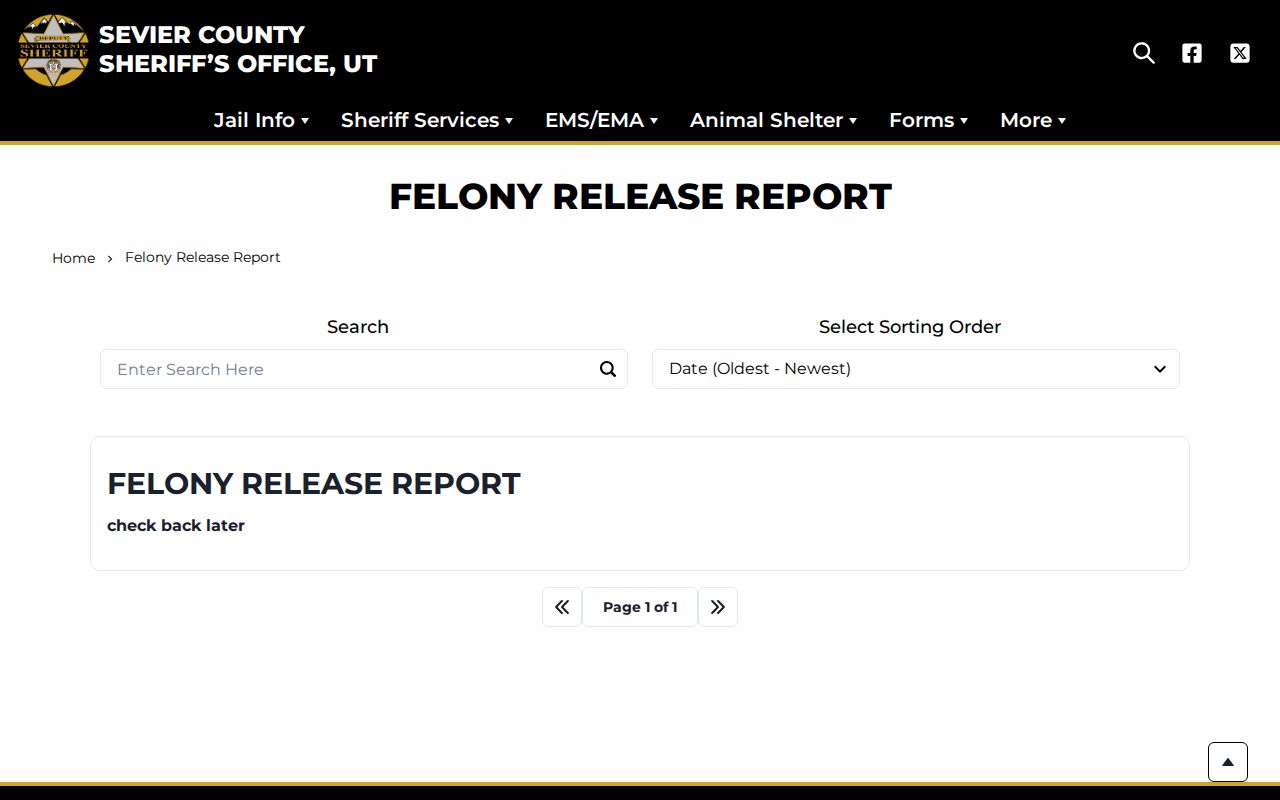
The empty report confirms why a same-day release must be checked through the jail, VINE, court record, or GRAMA response.
Note: Web display time and record retention are separate, and Sevier County publishes no verified online retention period for released entries.
Sevier Same-Day Source Order
Use sources in the order that fits the question. The jail is best for present physical custody and the recorded time a person left. Utah VINE is best for notice of a reported change. Xchange is best for the court action that may have caused the change. UDC and the Board apply when the person was a state prisoner or a contract inmate. A GRAMA response is the durable county record when the public web routes show nothing.
Identity comes first. Give the jail a full legal name, birth date if known, approximate booking date, and case or booking number. A spelling mismatch can look like release. So can movement to another facility. If the jail confirms departure, ask staff to state the event in its own terms. “Bond,” “court order,” “time served,” and “transfer” do not mean the same thing. Preserve the exact wording rather than reducing every event to released.
A court entry may appear before or after jail processing. That timing is not necessarily an error. Clerks enter legal orders, custody staff record physical movement, and VINE receives a separate agency feed. When dates differ, compare the event type and access time. For state custody, read the newest Board order because an earlier parole date can be changed or rescinded. For another county's detainee, request the legal custodian and case venue.
Records also have different lifespans. The public placeholder says nothing about how long the sheriff keeps a booking or release record. Ask the county records officer for the applicable series and schedule. If an entry is sealed, expunged, juvenile, investigative, or otherwise restricted, the custodian may withhold all or part of it. Request the public portions and the legal basis for redaction. A blank web result should never be used to bypass those limits. Keep the booking number with every inquiry, since one person can have more than one custody episode and each departure can have a different legal basis.