
Sevier County Scheduled Versus Actual Release
A projected or scheduled date is an expectation based on the record at a given time. Actual release is the physical custody event. The two can diverge because a court enters a new order, the jail applies credit, another agency has a hold, the Board revises a parole date, or release processing is not yet complete. The exact label matters. Utah's public UDC material calls one field “Parole/Expiration Date”; no separate live field literally labeled “Projected Release Date” was verified.
Pretrial custody works differently. Bond posting or a judge's release order can start the process, but neither creates a sentence-based good-time calculation. A person may still be held while staff verify the order, check other warrants, or resolve a detainer. For a sentenced county inmate, the judgment, credit already served, any eligible good-behavior credit, and other holds all affect the outcome. State prisoners require a Board decision plus UDC status.
Scheduled versus actual: A tentative hearing month or future parole date is not proof of physical release from Sevier County or Utah custody.
The strongest record names the date type, issuing authority, current status, and the time it was checked. Do not turn “not found” in a current roster into a release date. A missing name may reflect a transfer, spelling difference, restricted record, stale feed, or technical issue.
Find a Sevier County Release Date
Begin by sorting the person into county, state, federal, or immigration custody. Sevier County Jail houses local detainees, people for other counties, and UDC inmates under contract. The building therefore does not identify the agency that computes the date. Ask which entity owns the legal custody record and whether a departure would be community release or transfer.
- Confirm full name, date of birth if known, booking or offender number, sentencing court, and the type of custody.
- For Sevier Jail, call 435-896-2660 and ask for current custody, sentence or booking authority, projected information staff can release, and any hold.
- Read the signed court judgment and docket. Distinguish a pretrial release order from a county jail sentence.
- For a Utah state prisoner or UDC contract inmate, open UDC Offender Search and compare the offender number, legal status, housing location, and Parole/Expiration Date.
- Search Board Hearings and Decisions, open the newest order, and check for a later rescission or modification.
- On or after the expected day, confirm the actual event with the jail or UDC status. VINE may report a change but is not the legal computation.
A county-only arrest may never appear in UDC. Conversely, a UDC contract inmate housed in Richfield may need the state path even though the person slept in the county jail. If neither public portal settles a past event, request the existing jail custody/release entry under GRAMA. Ask for a record, not a new date calculation.
For a full named-person custody sequence beyond date computation, use the Sevier County released inmate search.
Note: The committing agency and offender or booking number are more reliable routing clues than the last building where the person was seen.
Sevier County Jail Date Calculation
A county jail date starts with the signed sentence and credit for time already served. Next, identify why the person is confined. Utah's county-jail good-behavior statute does not apply in the same way to every case. It addresses misdemeanor incarceration and jail confinement imposed as part of felony probation, subject to judicial exceptions. Staff must also determine whether another warrant, detainer, consecutive matter, or transfer authority keeps the person in custody.
Under Utah Code §76-3-403, the custodial authority may allow up to ten days of credit for each 30 days served for eligible good behavior. For a term under 30 days, it may allow up to two days for each ten. The statute says “may” and “up to.” The sentencing judge can also prohibit the credit in the circumstances the section covers. It is a ceiling, not a promise.
A 90-day eligible term illustrates the limit: 30 credit days would be the statutory ceiling, not an official release-date answer. Actual credit depends on the jail's award, time-served credit, the sentence language, and other custody. Publishing a calculator would hide those legal inputs. The proper check is the judgment plus the Sevier custodial authority's calculation.
Bond and pretrial release have no good-time formula. Court action, bond posting, verification of holds, and jail processing control. No official Sevier policy was found promising an earlier weekday release when a projected date falls on a weekend or holiday. Ask the jail about the named booking rather than assuming a Friday departure.
A records request can preserve the inputs when a past calculation is no longer visible. Ask the Sevier County Sheriff's electronic GRAMA route for the existing sentence-calculation, custody-movement, and release entries tied to the named booking, subject to lawful classification. Include the booking date and case number. Request any releasable field showing credit already served, good-behavior credit applied, the release authority, and a receiving agency. GRAMA does not require staff to invent a projected date or build a custom calculation, so frame the request around records the jail already maintains.
The sheriff's official jail page is also the right source for current contact routing. Its public site does not state a web retention window or a fixed release-date policy. A historic custody entry and the current live answer serve different needs, and each should retain its own access date.
Utah Prison Release Date Hierarchy
Utah generally uses indeterminate sentences for state-prison commitments. Under Utah Code §77-18-111, the judgment carries the statutory minimum-to-maximum range and continues to the maximum unless the Board sooner terminates or commutes it. The Board combines concurrent and consecutive sentences, applies credit for time served, and sets an original hearing under its rules. The range is a legal boundary, not a prediction that release will occur at either endpoint.
Read Utah dates in order. First comes the sentence range and credit information. A tentative original-hearing month then shows when the Board expects to consider the matter, not when the person will leave. A Board decision may set parole, rehearing, expiration, or more review. Finally, UDC status and the release-day custody record confirm the event. VINE adds notice, but does not compute the term.
The Board FAQ says the precise original hearing may be set only a few weeks before the tentative month, and the actual hearing can occur later. A granted parole date may also be rescinded before release because of behavior, a new conviction, or another issue within Board authority. Read every later order before relying on the first favorable date.
The official Board search shows the fields and decision route used for this check.
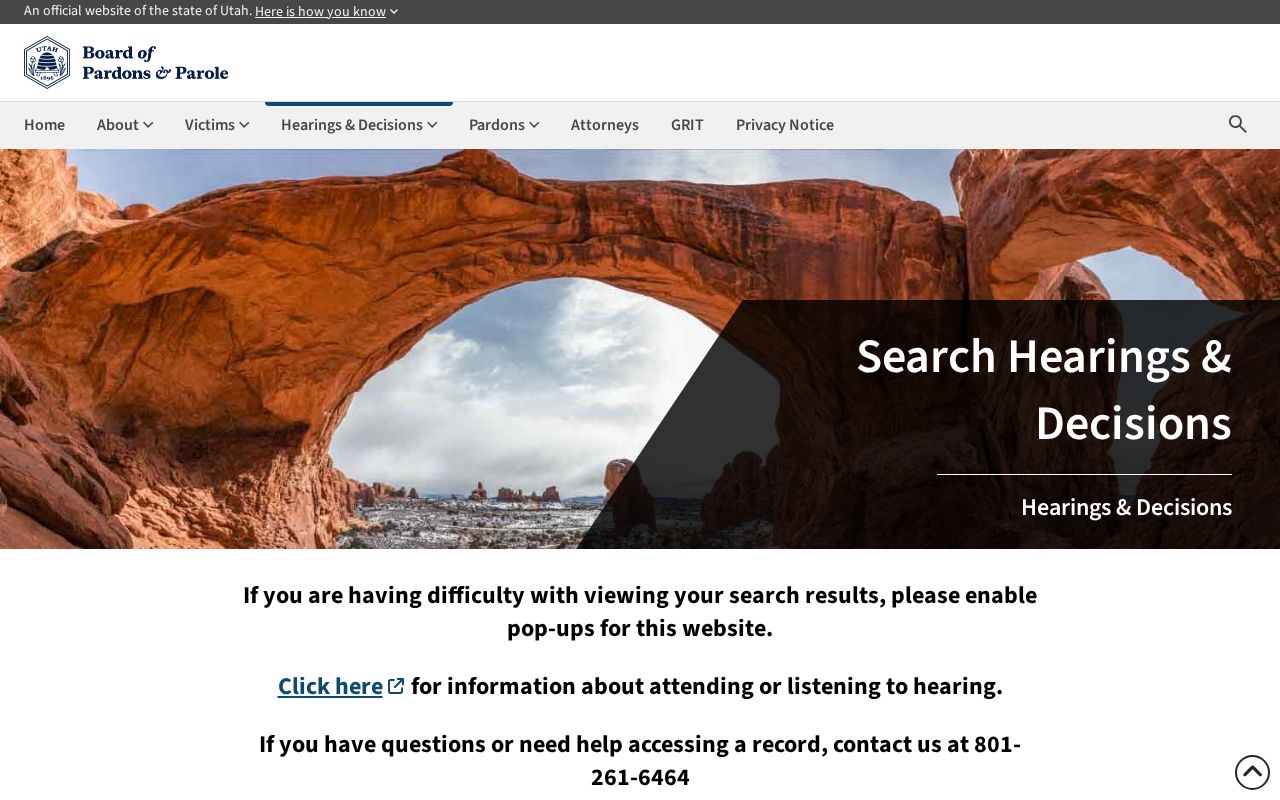
The captured search demonstrates why a person-level order is more useful than a broad hearing calendar.
Sevier County Good Time Rules
Utah sharply separates county-jail good time from state-prison parole. The county statute gives a custodian discretion within a stated ceiling for eligible jail terms. A prison sentence instead runs through the Board's indeterminate-sentence process. Applying the jail fraction to a state term would produce a false date, just as applying a Board hearing month to a local pretrial booking would.
There is no general Utah law requiring each prisoner to serve about 85 percent of the sentence. Offense-specific mandatory terms or limits may apply, and those must come from the conviction statute and judgment. The broad “85 percent rule” used in some other systems is not a valid universal Sevier County calculation.
State earned time is also not a flat percentage. Utah Code §77-27-5.4 and UDC's Earned Time Credit Programs material describe program-based mandatory and discretionary time cuts. Qualifying completion of up to two approved programs can move an existing Board date by at least four months each, up to eight mandatory months, but exclusions, unmet Board contingencies, feasibility, forfeiture, and rescission can apply. The change acts on a Board date. It is not automatic day-for-day credit.
This distinction is the key Sevier release-date computation quirk. A short eligible county term needs the jail's credit decision. A UDC sentence needs the judgment, Board order, earned-time record where relevant, and actual status. No single percentage safely bridges both systems.
Note: Cite the statute and current order for the named case rather than importing a release formula from another state or federal custody.
Why Sevier County Release Dates Change
A date can move for legal, disciplinary, custody, or record reasons. Some events change only a hearing date. Others alter the controlling release authority. Read the source document before describing the effect, especially when a person is held at Sevier Jail for UDC or another county.
| Factor | Possible effect | Source to check |
|---|---|---|
| Corrected sentence or time-served credit | Changes the lawful calculation boundary | Court judgment and custody calculation |
| Additional consecutive case | Extends the combined range or custody | Court record and Board computation |
| Good-behavior or earned-time decision | May move an eligible jail or existing Board date | Jail record or UDC earned-time record |
| Board rehearing or redetermination | Replaces an earlier review plan or date | Newest Board order |
| Rescission or discipline | May withdraw a parole date before release | Board and UDC records |
| Pending charge, warrant, or detainer | May prevent community release or cause transfer | Court, jail, and receiving agency |
| Approved-address or report issue | Can delay parole processing or a hearing | Board order and authorized agency contact |
Board materials note that missing reports, pending charges, and scheduling capacity may move a hearing. That does not always mean the sentence or parole date changed. Describe a rescheduled hearing as a hearing change unless a later order sets a new release outcome.
Confirm Sevier County Actual Release
On release day, compare the controlling document with live custody status. For a local sentence, call Sevier County Jail and ask whether the person physically left, the time, and whether the departure was community release or transfer. For a UDC prisoner, follow the official UDC Release Day FAQ: verify the date through Offender Search or the Board, then check status on or after the expected day.
Utah VINE can send a release or custody-change alert. It can also report moves between prison sites, county jails, and community correctional centers, so the event text must be read. The Sevier County VINE inmate check explains how to register and confirm telephone notices. VINE is support, not the legal order.
If the date passes without a clear status, check for a later Board order, a detainer, another court case, or a transfer. A Sevier Jail departure to UDC, another county, federal authorities, or another custodian is not release to the community. The receiving agency becomes the next source.