
Sevier County Parole Versus Probation
Utah assigns parole and probation through different legal paths. The Utah Board of Pardons and Parole decides whether and when a parole-eligible state prisoner may leave prison. It may set or amend conditions, revoke parole, terminate a sentence, commute a sentence, or issue a pardon. The Utah Department of Corrections Adult Probation and Parole division, called AP&P, handles field supervision after release. A parolee has left prison, but remains under the sentence and Board authority.
Probation is imposed by a court. A Sevier County defendant may receive probation without serving a state-prison term, or may serve jail time as one part of a probation order. The court docket is therefore vital when the question is probation. UDC Offender Search can show a state-supervised probation status, but a Board parole search does not explain an ordinary probation order. Neither label should be treated as full discharge.
| Point | Parole | Probation |
|---|---|---|
| Who orders it | Utah Board of Pardons and Parole | The sentencing court |
| Custody history | Follows release from a state-prison sentence | May be ordered without a prison term |
| Public verification | UDC status plus the newest Board order | Court docket plus UDC status when AP&P supervises |
| Field supervision | UDC Adult Probation and Parole | UDC AP&P when assigned by the court |
| How it ends | Board termination or sentence expiration | Court discharge or expiration under the order |
- Parole
- Community release from prison while the sentence and Board authority continue.
- Probation
- Court-ordered community supervision that may replace or follow confinement.
- Discharge
- The end of the applicable sentence or supervision authority, not merely release from a building.
- Absconder
- An official allegation that a supervised person is unavailable or not complying, not a new conviction.
Check Sevier County Post-Release Supervision
Use an identity-first check. UDC limits its public Offender Search to people currently under its jurisdiction or supervision. That makes it useful for an active parolee or a state-supervised probationer, but not a full archive of everyone once supervised. First and last name are required for a name search, with middle name optional, or the search can use an offender number. Compare the number, photograph, legal status, location, and available dates before deciding the result belongs to the right person.
The Board's Search Hearings and Decisions accepts the same core name fields, an offender number, or a date range. Its order documents can show parole granted for an effective date, rehearing, termination, rescission, or another result. Read the newest order and check for later action. An old parole grant can be changed while the Board still has jurisdiction.
- Collect the full legal name and offender number if known. Use a second identifier for a common name.
- Open the official UDC Offender Search landing page and review the current legal status.
- Search the Board by offender number or required first and last name. Open the newest decision, then look for later modifications.
- For probation, check the controlling court docket through Utah Courts and read the sentencing and later supervision entries.
- Use UDC's current AP&P office directory to verify the assigned office. Do not infer assignment from an old address alone.
- If the person recently left Sevier County Jail, confirm whether the departure was community release or transfer before treating it as supervision.
Important: A hearing date is not a release date, and physical release does not mean the sentence or supervision has ended.
For the broader custody and release-record sequence, the Sevier County released inmate search separates jail, state, federal, and court sources.
Note: Preserve the exact status text and access date because a later order, warrant, violation, or data correction can change the result.
Sevier County AP&P Office
AP&P Region 4 has a Richfield office that serves Sevier County along with Garfield, Juab, Millard, Piute, Sanpete, and western Wayne counties. It is the local operational contact for office and reporting matters after a Utah parole or state-supervised probation assignment. The nearest office is not always the assigned office. UDC may change assignments, and staff generally cannot disclose private case-management details to an unrelated caller.
UDC AP&P Region 4 Richfield
835 East 300 North, Suite 500
Richfield, UT 84701
435-896-2770
The office verifies its own current routing. The Board remains the decision-maker for parole dates, conditions, revocation, and sentence termination. AP&P administers supervision in the field. Keeping those roles separate avoids asking the local office to reinterpret a public Board order or asking the Board for a day-to-day reporting detail.
The official AP&P page shows the Richfield office in context.
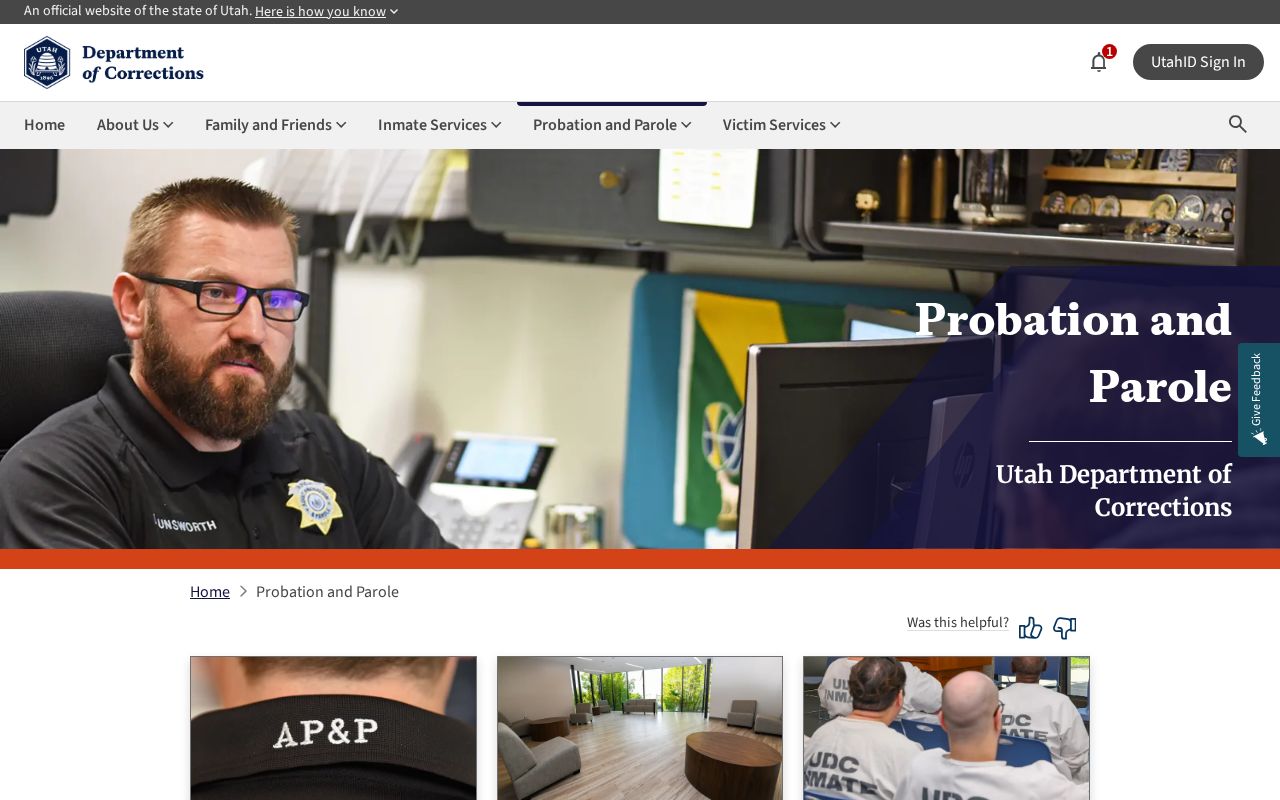
The captured agency page is the source to recheck because regional coverage and assignments can change.
Sevier County Parole Decision Records
A person-level Board search is stronger than relying on a general calendar. Results can include upcoming hearings and prior orders, and known aliases may appear. Utah uses several proceeding types: an original hearing, parole-violation hearing, rehearing, rescission hearing, redetermination, and paper or special-attention review. Each has a different function. The final document may set parole, schedule more review, permit sentence expiration, terminate a sentence, rescind a date, or leave an issue under advisement.
Use the order's own words. “Parole granted” for a future effective date is not proof the person has already walked out. A later rescission or modification may control. On and after the expected day, compare the order with UDC status. The UDC Release Day FAQ directs readers to Offender Search or the Board site to verify a parole or release date. VINE can add notice of the event, but does not replace the legal order.
Utah's indeterminate prison sentences also make the order important. Under Utah Code §77-18-111, an ordinary prison judgment runs within its statutory minimum-to-maximum range unless the Board sooner terminates or commutes it. A tentative hearing month is not a promise of parole or discharge.
Sevier County Supervision Violations
Conditions differ by order, so a public summary should remain general. A person may have reporting duties, approved residence or travel limits, treatment requirements, or other terms set by the court or Board. The signed order controls. A claim from another source should not be substituted for its text, and a supervision office normally will not release private management detail merely because someone asks.
An alleged parole violation can lead AP&P to seek a Board warrant and return the person to custody. The Board explains that a violation hearing follows execution of the warrant. Waivers, pending charges, and the posture of a new case may affect timing. “Absconder” or “warrant” should be repeated only when an official source uses that label. It alleges noncompliance or unavailability; it is not a finding of guilt on a new charge.
No verified public Sevier County absconder list was found. Check the current UDC status, newest Board material, and relevant court docket rather than relying on an unofficial list. Utah VINE can report custody movement, but a move to a jail or prison is not itself a new conviction or a final parole ruling.
Note: A custody return after an alleged violation changes location, while the later Board order explains the supervision consequence.
Sevier Jail Reentry and Parole
Sevier County Jail participates in the UDC county-jail program. The state's dated county-jail inventory lists local education, treatment and religious activities, plus work crews. Those programs help explain why a person under state authority may be housed in the Richfield jail. They do not prove that a participant has been released. Work outside the secure building under authorization is still custody.
The distinction matters at release. The Sevier County sheriff says the jail houses people for three counties and UDC. A person can physically depart the jail yet remain in official custody through a transfer. If the individual is a UDC contract inmate, the Board order and UDC status control parole, while AP&P handles supervision after actual community release. Ask the jail which entity was the legal custodian and which agency received the person.
A local pretrial release is different again. It may place a person in the community under case conditions, but it is not parole and does not show that a sentence was discharged. The court record identifies that authority. This mixed-custody setting is why a building-based search alone cannot resolve Sevier County post-release supervision.
Correct Sevier County Supervision Records
Send a correction to the office that owns the record. A Sevier sheriff booking or release error belongs with the sheriff's records custodian. An Xchange docket error belongs with the clerk of the court that maintains the case. A UDC legal-status or location error goes to UDC, while a Board decision issue goes to the Board. One agency cannot reliably rewrite another agency's record.
Utah Courts identifies clerks as the official keepers of court records. Public Xchange excludes sealed and expunged cases. An authorized person may still see “Case Expunged” in MyCase, but public absence after expungement is not a jail-feed failure. When records disagree, provide the name, case or offender number, exact disputed field, source, and access date to the proper custodian.
The record owner rule also protects against overcorrection. A parole label can be correct while an old jail roster is stale, and a release timestamp can be correct while the court case remains open. Fix the wrong field at its source instead of asking every system to display identical information.
When Sevier County Supervision Ends
Release, termination, and expiration are separate events. A parolee leaves prison for community supervision, then remains under the sentence until the Board terminates it or the controlling maximum expires. A probationer remains bound by the court order until the court discharges the case or the authorized term ends. The latest official order is stronger proof than a missing search result.
For parole, review later Board decisions as well as the first grant. A termination or sentence-expiration order is closer to discharge than a parole effective date. Then compare UDC status. Because Offender Search covers current jurisdiction, a fully discharged person may no longer appear. That disappearance is consistent with the portal's scope, but is not proof by itself.
For probation, read the court docket for discharge, termination, revocation, or extension. If AP&P handled the supervision, its status can support the court record. Keep the record type clear: the sheriff proves when a person physically left Sevier Jail, the court or Board defines legal supervision, and UDC reports current state jurisdiction.